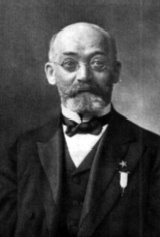
Reading about the constructed language, Esperanto, created by
L.L Zamenhof and first published in 1877, really opened many other doors of thought for me. It is today the most widely spoken constructed international language, and it is thought that up to 2 million speakers in mainly Russia, China, Japan and Eastern Europe speak the language either as native speakers or as a second language.
The objective of
L.L. Zamenhof was basically to create a language, that happened to be influenced by Polish, German, French and Russian, that would work as a unifying force and international second language. The thought is inspiring, for indeed often lack of communication is the basis of unsolved differences.
However reading on, one is automatically lead to the
Bahá'í faith founded by
Baha'ullah in the early 1800's in Iran. The idea of unity of humanity being of great importance to
Baha'ullah, he speaks of an international auxiliary language, basically one language that will work as a second unifying language learnt by everyone in addititon to their native tongue, as a means to create peace and understanding.
Could
L.L. Zamenhof have been influenced directly by the
Bahá'í faith whilst developing the Esperanto language? After all, his daughter
Lidia Zamenhof later became a member of the
Bahá'í faith.
Baha'ullah himself names three languages that could work as that one unifying language, and Esperanto is one of them, along with English and Arabic. Today however mainly Persian and English is used as a means of communication on a wider basis among the
Bahá'í followers.
Zamenhof wrote a poem called
"La Espero" (The Hope), and it is today often referred to as the anthem of Esperanto. A verse from it leads:
Sur neŭtrala lingva fundamento, ---On a neutral language basis, komprenante unu la alian, ---understanding one another.
la popoloj faros en konsento ---the people will make in agreement
unu grandan rondon familian. ---one great family circle.It is interesting, this idea of one language unifying the world. One could argue that English already works as such a language, being very often taught as a second language at schools all over the world.
When it comes to Arabic, it can't be equated to the standing of English in terms of being a language that has the same demographic stretch. Yet, on the other hand, many Arabic terms that were derived from the religious connotations that they held, such as
alhamdolillah,
insha'Allah and
masha'Allah, are used from Bosnia to China to Mexico and Kenya, by Muslims (practicing or non practicing), and native Arabic speakers of whatever ideological affiliation.
This function of Arabic (for more than a billion people), is something that is unprecedented, linguistically, anywhere in the world even though many might argue that English has achieved a similar function. The
Bahá'í followers however, are yet to announce the unifying language of their choice that will work as the second language of the world however I have my bets on Esperanto.
For those of you who wish to see the language used in an everyday fashion, there is an
interesting blog by an Arab Emirati called Samawel, who learnt the language by studying it online.
 In Tanzania or Tanganyika as it is called in Swahili, a large population of Muslims live. Being almost half of the country's population, Ramadan of course does not go unnoticed.